

Industry 5.0 – Orientation for Innovators and Expert Communities
This publication is prepared for the March 11-12 matchmaking event by APPAU that will bring together our leading developers and integrators, EDIH experts, universities, and industrial high-tech startups. Since the topic has already been set and aligns with our previous developments, it is important to clarify the key focuses and preparation tasks (primarily for speakers). Despite its growing popularity, the concept of Industry 5.0 remains somewhat disconnected from Ukrainian realities. As usual, we will outline this orientation through five key tracks, from strategies to tactical tasks within the community.
Track #1 – Conceptualization, Principles, and Foundations
The quintessence of the first national conference on Industry 5.0 in July 2023 resulted in two fundamental documents – the Manifesto 5.0 and the Conference Resolution. The first document clearly articulates the long-term principles of Industry 5.0, adapted to the Ukrainian context. Most of them align with the concept of European Industry 5.0. Still, there are notable differences. In particular, we place Governance 5.0 as the top priority and focus significantly more on integration with the defense sector than the green transition. Preserving human capital in wartime conditions is also particularly important, possibly even more so than in the EU.
It is important to recall that the document was signed by nearly 40 stakeholders, including 26 clusters of the Ukrainian Cluster Alliance (UCA)! As for the Resolution, all of its conclusions, like those of the Manifesto, remain highly relevant and underscore the thoroughness of these documents. Specifically, point 6 of the Resolution, which calls for the real and accelerated implementation of key industrial and innovation policy tools, such as innovation clusters and EDIHs (the foundation of innovation ecosystems), remains a focal point of attention. This is directly relevant to the conference on March 11-12, as our clusters are key participants, and the event will take place at Kyiv Polytechnic Institute, one of the main participants of EDIH Kyiv HiTech.
Orientation for Experts: Both documents serve as a checklist to evaluate our progress at the community and governmental levels. For example, while we have made progress in the twin transition (such as the first roadmap for the textile industry) and cluster policies (the Clusters4Regions project), in other aspects—such as the State Agency 5.0—there has been no progress at all. More comprehensive and detailed reviews of all points outlined in these documents are highly encouraged.
Track#2 – Connection with Current and Upcoming National Strategies
At the 2023 conference, the first 5.0 strategy framework was introduced, integrating multiple levels of strategizing—from tools and institutions to key economic indicators. The logic is clear: the stronger and more balanced the Tools and Institutions, the higher the likelihood of developing high-quality, effective policies and strategies, leading to targeted programs with greater chances of successful implementation, ultimately delivering measurable outcomes and impacts on the economy.
Figure 1 provides a somewhat subjective view of the current state of these elements, mainly to illustrate cause-and-effect relationships. The green elements highlight areas where progress has been made, while the orange elements indicate critical gaps where urgent change is needed.
For example, the emergence of just one but highly effective accelerator in the defense industry (Brave1)—which includes grant support for innovation—has triggered a growth trend in innovation within the sector, ultimately strengthening the entire defense ecosystem. This accelerator, backed by the Ministry of Digital Transformation (MinTsifra), is marked in green at the bottom of the diagram, showcasing a textbook example of successful synergy between Tools and Institutions.
The key question now is:
📌 Are similar processes happening in other key industries, such as manufacturing, energy, infrastructure, and transport?
📌 Or has the defense sector become an exception due to specific, well-known factors?
Understanding these dynamics is crucial for shaping the next generation of national strategies and ensuring that successful approaches in one sector can be adapted and scaled across other critical industries.
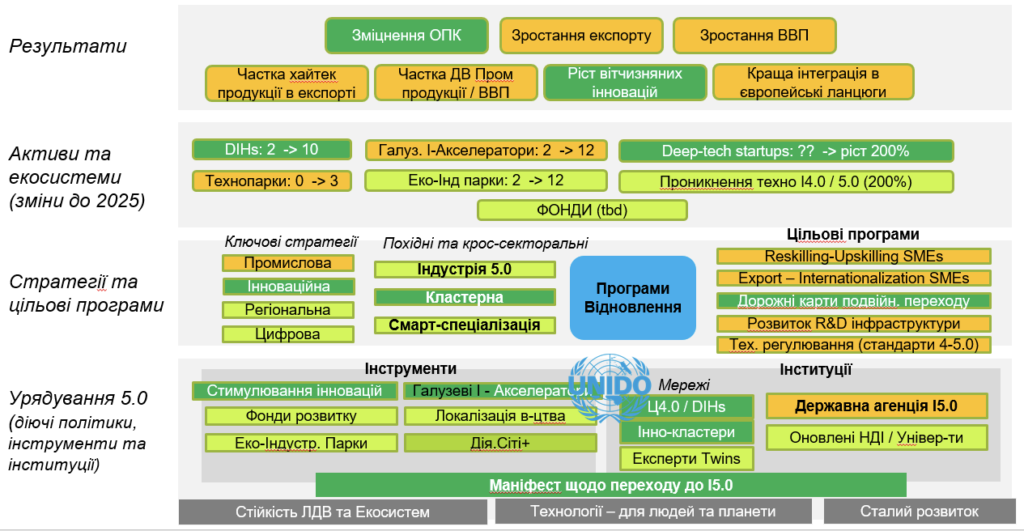
Figure 1. Policy and Strategy Framework for Industry 5.0
Orientation for experts: The primary focus should obviously be on new strategies currently being developed by the government. At UCA, we have already reviewed the WINWIN innovation strategy in February and drawn key conclusions. The main takeaway is that while the strategy remains underdeveloped, particularly in its operational aspects, we still see multiple alignment points and interactions with the Ministry of Digital Transformation. Several of our Working Groups and Committees are already progressing along this path. Similarly, it is essential to analyze developments in other sectors and policy areas, identifying priority areas for collaboration in the same way.
Track#3 – Synchronization and Alignment with the European Space
This is a complex yet crucial issue. As of today, our development is entirely dependent on EU funding, and in light of recent geopolitical shifts, this dependence is only growing. Therefore, all our experts must have a deep understanding of the European course on Industry 5.0, its challenges and opportunities, mechanisms, key projects, and communities and networks.
The first step we took in the fall of 2024 was to “mirror” the European Community of Practice 5.0 within our own framework. Here’s what it currently looks like:
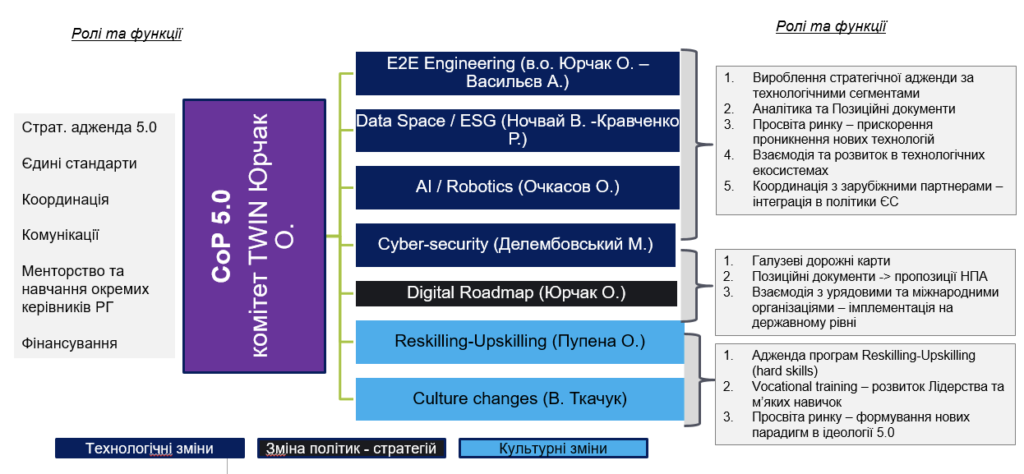
As shown in Fig. 2, each Working Group’s primary task is to develop a strategic agenda within its sector. One of the most notable examples today is the already mentioned Twin Transition Roadmap for the Light Industry, which generates 80 initiatives across six categories—from changes in the innovation ecosystem to the integration of approaches in digital and green technologies.
At the same time, it cannot yet be said that the Ukrainian context fully aligns with the European one. Here are some key areas where we lack alignment (even at the conceptual level):
- Better understanding, conceptualization, and practical application of the concept of human-centricity. Even in the EU, this is a complex issue, but European countries are conducting numerous experiments and projects in this field. However, this topic is hardly discussed in Ukraine, even at the academic level, despite having ample ground for development. This is particularly evident on the frontlines, where technologies play a crucial role in saving lives.
- There should be more consolidated and proactive efforts to implement specific principles of Industry 5.0. For example, the GDT Textile project clearly demonstrated significant fragmentation and a lack of communication between the government and businesses regarding the green transition. Similarly, such consolidation—even at the level of expert communities—is missing in many other Industry 5.0 topics, particularly in Industrial AI.
- Stronger integration of technological approaches and strategies with the defense sector. The division between the defense industry and the green transition in the EU still dominates, appearing artificial and disconnected from current realities. Given its wartime conditions, this integration is not just necessary but critically important for Ukraine.
The agenda of the March 11 conference includes a presentation by a European Commission representative, alongside discussions led by the heads of four other projects that AППАУ and UCA are already implementing within the framework of Industry 5.0.
Experts are encouraged to review two key documents:
- The European Commission’s “Transformative Vision of Industry 5.0” (2021) – translated into Ukrainian
- Mario Draghi’s new report (2024) – is directly related to the principles of Industry 5.0, particularly governance efficiency.
One key cause of the current crisis in both the US and the EU is the low efficiency of government policies in response to global challenges. In Ukraine, the lack of an industrial policy and strategic governance in the defense sector over the past 10+ years has led to critical dependence on Western supplies. Today, we are closing this gap through extraordinary efforts, including the sacrifices of our soldiers.
For more information on European Industry 5.0 policies and documents, visit the European Commission website.
Track#4 – Sectoral Focus
Our experts feel most confident in specific technological and industrial segments. This is indeed one of our strengths at APPAU and, more broadly, within UCA. We have developed a strong portfolio of innovative solutions and products across the technological segments shown in Figure 2 above and in key industrial sectors such as agri-food, metallurgy, mechanical engineering, energy, and infrastructure.
Twelve of APPAU’s top innovators will be showcased on March 11 for an international audience and on March 12 during offline meetings at KPI (Kyiv Polytechnic Institute). APPAU brings together dozens of engineering companies and system integrators. For this event, we have selected those with advanced Industry 4.0-5.0 solutions and experts from EDIH Kyiv Hitech.
We strongly encourage event participants to meet them in person. Only through direct interaction can you fully grasp their level of expertise and explore potential collaboration opportunities.
We are planning dedicated preparatory meetings for the experts and speakers from the participating companies from March 11 to March 12 ahead of the event.
Track#5 – ecosystem alignment and consolidation
Over the past three years, significant changes have occurred within the Industry 4.0 community, primarily through its expansion into the country’s cluster movement. Since 2022, APPAU has invested a significant portion of its financial and human resources into developing UCA. Practically all CoP 5.0 Working Groups, major twin transition projects in recent years, including the development of DIH KPI, are related to APPAU’s activities. The ideas and solutions of Industry 4.0–5.0 are gaining more supporters across various circles in Ukraine. On the other hand, these three years have also highlighted systemic problems and gaps, including within the UCA community.
- There is a significant difference between those who genuinely develop modern Industry 4.0–5.0 products and solutions and those who capitalize on these trends’ hype. This also applies to several UCA clusters lacking the expertise and understanding needed to move forward in this domain.
- It also concerns the newly established EDIHs (not just the Kyiv one) – the gap between the declared services for SMEs, and the consistent delivery of high-quality digitalization services remains very large.
- Even within APPAU, support for the Industry 4.0–5.0 course is not universal. The issue is not just about technology but also about the willingness to collaborate and cooperate in the ecosystem.
Guidance for all experts and participants: the March 11–12 events will be an excellent opportunity for networking and matchmaking among participants. You will have the chance to meet and discuss with leading industrial high-tech solution providers, integrators, and end customers personally. We also anticipate the participation of policymakers (representatives of government organizations) and international partners.
Final recommendations
Following the core principle that half of an event’s success lies in thorough preparation, here is what participants should prepare for on March 11–12.
- For APPAU and UCA Experts:
- CoP 5.0 Groups: Prepare your sectoral development agendas, including policy recommendations for policymakers.
- APPAU Integrators & Developers: Highlight Industry 4.0–5.0 elements in your solutions.
- EDIH Kyiv Hitech: Present and communicate your digital transformation services package to SMEs.
- Innovation and TWIN Committees of UCA: Finalize positions and proposals on twin transition and Industry 5.0 for submission to government bodies.
- CoP 5.0 Groups: Prepare your sectoral development agendas, including policy recommendations for policymakers.
- Cluster Coordinators from Industrial Sectors: Engage your leading SMEs in this conference. This is the best opportunity for them to understand the shift from previous technological paradigms and map out their own path toward Industry 5.0.
- Universities and Industrial Enterprises: Actively participate in matchmaking by scheduling meetings with key developers and integrators for potential collaboration.
We look forward to seeing you at the March 11–12 matchmaking sessions.
Detailed program and registration: https://appau.org.ua/en/matchmaking-in-the-industry-5-0/
APPAU Executive Directorate