
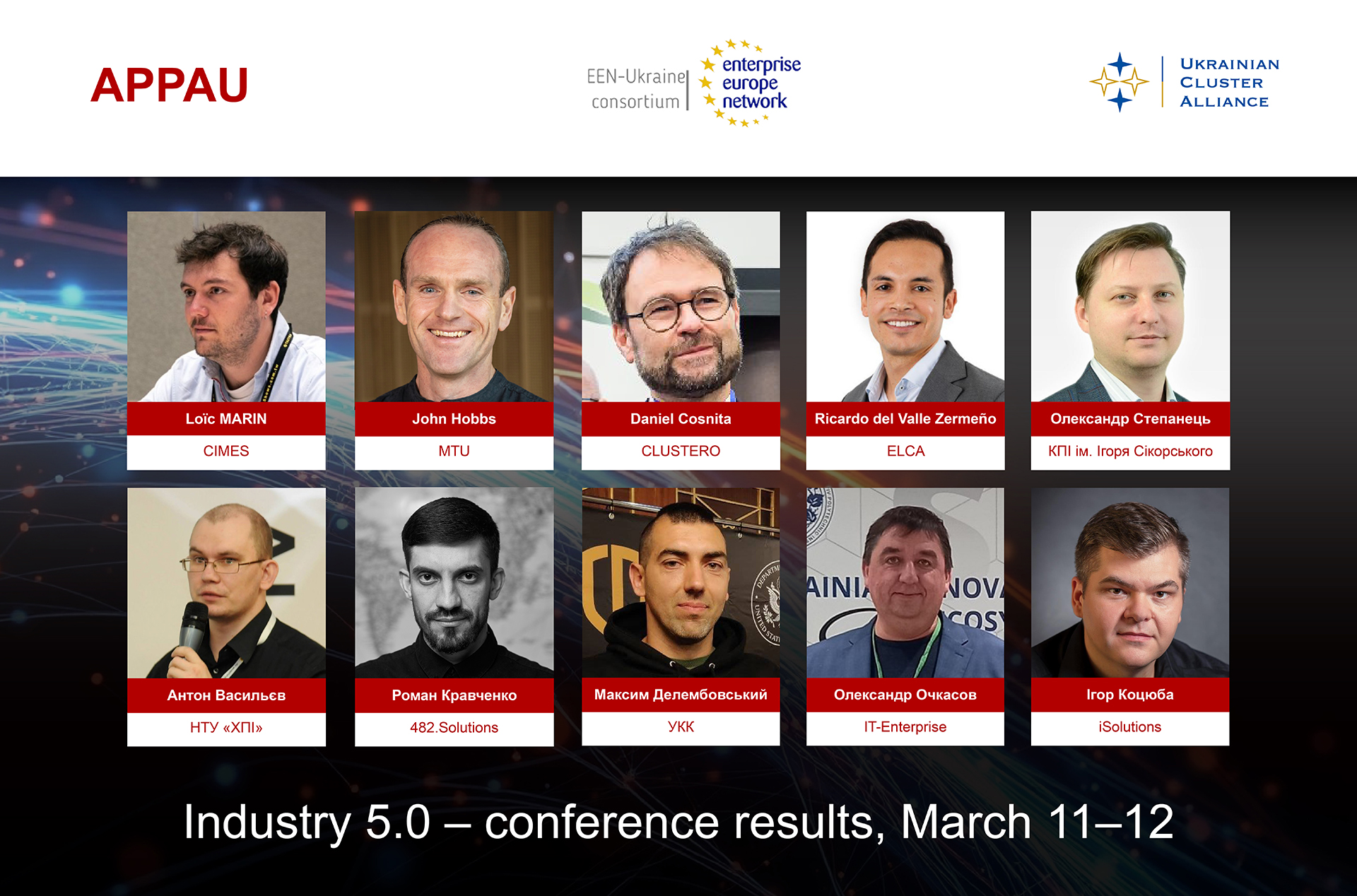
Industry 5.0 – Summary of the March 11-12 Conference
The Industry 5.0 Conference, held on March 11-12, was conducted in a hybrid format to align and connect key Ukrainian and European stakeholders. The event attracted over 140 registered participants, including 45 international attendees. This report summarizes the key messages and action directions of the Industry 5.0 community.
General Context
This conference was the first major event since July 2023, when key UA policy documents—the Manifesto and Resolution—were adopted. The March 11-12 event aimed to demonstrate progress in several key areas:
- Implementation of the 10 fundamental principles of the Industry 5.0 UA Manifesto
- Advancement of sectoral agendas through the Industry 5.0 Community of Practice (CoP)
- Alignment with European stakeholders
- Institutional progress, particularly with the Ukrainian Cluster Alliance (UCA) and EDIHs
Preparations for the event were mainly carried out within CoP 5.0_UA, where Working Group (WG) leaders formulated consolidated positions. For international partners, one of the key messages tested during the conference was the integration of Dual-Use/MilTech sectors, which share core manufacturing foundations with traditional Industry 4.0-5.0 sectors.
Key Speeches & Messages
Zuzana Dutkova from the European Commission’s Research and Innovation Industry 5.0 and AI in Science Directorate provided valuable information on the progress of I5.0 in the EU, including key projects such as Prospects 5.0, SEISMEC, AI Redgio 5.0, SURE 5.0, and Bridge 5.0. Suzanne’s call for Ukrainian experts of the SD 5.0_UA to join the European I5.0 platform was important. Horizon Europe projects remain the main instrument for financing I5.0 projects.
The speech by Oleksandr Yurchak, CEO of APPAU and leader of the Ukrainian SoP 5.0 community, set the framework and direction for the conference discussions. Oleksandr emphasized that in 2024, the Ukrainian community of UCA and APPAU made great strides towards integration into European projects related to Industry 5.0 (see below), achieving some synergy between individual clusters and EDIHs. There has also been some progress in strategically aligning priorities with the Ukrainian government. Instead, the development challenges look like:
- Lack of financial instruments and programs to support specific needs, such as Reskilling-Upskilling programs, testbeds and laboratories, and industrial accelerators.
- The limited engagement of large industrial companies and international institutions—support remains weak.
The APPAU presentation about Ukrainian challenges and perspectives in I5.0 is here
CoP5.0_UA WG leaders Anton Vasiliev (End2End Engineering/PLM), Oleksandr Ochkasov (AI/Robotics), Ihor Kotsiuba (CyberSecurity OT), Data Space/ESG (Volodymyr Nochvay—Roman Kravchenko), and Pavlo Novikov—Reskilling/Upskilling program from EDIH Kyiv Hitech—presented segment development agendas.
The general message from the leaders of the Ukrainian CoP 5.0 is a call for cooperation on specific projects being developed in each WG. For example, within the Reskilling / Upskilling program, there are 5 project applications where EDIH Kyiv Hitech is looking for cooperation with European partners—from market awareness campaigns and SME engagement to training teachers and trainers in modern 4.0 technologies.
The four projects already underway by the UCA and APPAU have demonstrated our course towards integration into EU programs:
- IDEALIST – Twin Transition of SMEs in three industrial sectors (Loïc Marin & Alysée Cibil, France)
- Accelerate GDT – Green & Digital Transition in cluster policy (John Hobs, Ireland)
- DanubIA – AI-driven transformation of cluster strategies (Daniel Cosnita, Romania)
- Lightweight EU – Advanced materials addressing new industrial challenges (Ricardo del Valle, Spain)
Discussions in six Zoom breakout rooms were highly engaging, contributing to networking and the consolidation of CoP 5.0 working group positions. On March 12, eight Ukrainian integrators and developers presented their Industry 4.0-5.0 solutions, showcasing Ukraine’s technological capabilities.
Progress of Ukrainian I5.0 and Strategic Alignment
The conference was especially useful for consolidating the Ukrainian CoP 5.0 community, developing common positions, and aligning them with the European course. The conclusions regarding progress and changes over the past period are as follows:
- The Ukrainian CoP 5.0, as a replication of the European CoP 5.0, appears to be a successful experiment. While the six working groups that have started their activities are not yet fully integrated into the European agenda, they can effectively mirror the work of the European CoP 5.0, adapt it to Ukrainian markets, and contribute Ukrainian ideas and insights to the European agenda.
The Ukrainian CoP 5.0 is an excellent example of how EU initiatives can successfully replicate at the national level.
Zuzana Dutkova, RTD E4, European Commission
- The Ukrainian contribution to the pan-European Industry 5.0 concept could be integrating and developing the Security component. There are many common denominators, including the Defense industry sectors. Still, even more important today is the leadership of the UA MilTech sector, which is currently driving advancements in key technology areas such as AI, Robotics (including UAV/UGV), Cybersecurity, and Photonics. Discussions at the conference highlighted synergistic projects between MilTech and general industrial sectors, such as developing rapid prototyping centers.
- The significant progress of Brave1, Ukraine’s state-backed MilTech accelerator, provides hope and proof of this model’s effectiveness for other critical industries. If we see such a surge in innovation and production growth in MilTech, should similar accelerators be implemented in other high-potential sectors such as agri-food, machinery, and energy?
- Innovation clusters, EDIHs, and industry accelerators represent the three pillars of regional and sectoral innovation ecosystems. Since 2021, APPAU has been promoting this concept (including in its proposals for NES 2030), and today, we have numerous confirmations of its validity. Together, these three types of organizations can drive breakthroughs in any industry.
- For Ukrainian stakeholders, particularly UCA clusters, it is crucial to understand and align with European best practices, as demonstrated by our EU partners. We observed successful approaches to the dual transition, advanced technology adoption, and knowledge transfer at various levels—in cluster policies, SME strategies, knowledge-sharing platforms, and sectoral roadmaps. Ukrainian communities have a lot to learn from European expertise.
- For European stakeholders, it is essential to recognize how quickly APPAU and UCA convert new EU project experience and new connections into tangible outcomes and impacts—often within the project timeframe. A prime example is Accelerate GDT. UCA’s participation has already led to two spin-off initiatives: the National Cluster Development policy development and the Clusters4Regions project, which focused on the development of regional cluster development programs in six Ukrainian regions. Remarkably, less than a year has passed since Ukraine joined Accelerate GDT, yet we are already seeing significant results.
At the same time, the conference also included a kind of criticism of European and Ukrainian institutions responsible for developing industrial high-tech sectors. In particular, the following areas remain problematic or show minimal progress:
- Weak governance of Industry 5.0: Over all past years, we have not seen any comprehensive strategies or support programs for Industry 4.0 / 5.0 in Ukraine. Most high-tech industrial communities remain highly fragmented, and new European projects and programs exacerbate this fragmentation.
- In particular, this fragmentation has affected the cluster movement, where two European programs (support for EDIHs and the EU-Ukraine Clusters Partnership) seem to be further diluting our stance instead of strengthening consolidation around UCA’s positions (including CoP 5.0).
- EDIHs support projects hardly take into account the local context, particularly universities’ complete unpreparedness to transition to service models for SMEs and the weakness of R&D infrastructure.
- The availability of other targeted programs to support the development of Industry 4.0-5.0 remains uncertain and no donors support this movement.
There are many such growth challenges, so APPAU’s call to institutional partners remains the same: “Let’s consolidate and integrate around common strategies.”
This call directly opposes the fragmentation, significantly weakening the Ukrainian Industry 4.0-5.0 movement overall.
At the same time, there are growth opportunities within UCA and APPAU. Specifically, this involves engaging SMEs and large companies, including international brands in industrial automation and IT operating in Ukraine. These companies could significantly strengthen our movement and help develop new strategies and projects.
Next Steps for Ukraine’s Industry 5.0 Development
The emergence of the CoP 5.0_UA community and its initial results represent a significant step forward in developing APPAU and UCA. De facto, these Working Groups (WGs) are setting new rules for clusters and EDIHs (more broadly – universities). They confirm UCA’s thesis regarding the strategic impact of small but truly expert and well-organized WGs, which become centers of larger communities. True professionals lead the CoP 5.0_UA WGs with relevant technical backgrounds, and this is the main change we have managed to achieve under the strong negative influence of fragmentation and populism. Seven draft frameworks have been developed – Robotics, Asset Performance & Safety Management, Cybersecurity, E2E Engineering (PLM), Federative Data Space, Circular Manufacturing, and Reskilling Upskilling. Each of them has its priorities on which the WGs are focused. Accordingly, the action directions for 2025 are as follows:
Strategically:
– UCA and APPAU must strengthen the composition of the CoP 5.0_UA WGs, which are the foundation for innovation cluster networks, EDIHs, prototyping centers, and R&D.
– Finalize, document, and communicate the developed strategic frameworks to all key stakeholders, primarily government authorities and international donors.
– Continue active integration into European projects, primarily Horizon Europe.
– Conduct a series of advocacy initiatives to address two strategic gaps in our movement:
a) the lack of programs to strengthen the infrastructure of shared R&D centers in industry,
b) the involvement of leading international brands and European institutions, including international donors, in the Ukrainian 5.0 movement.
– Focus on joint synergistic projects between 5.0 directions, such as:
- Federative Data Space platforms (as shared environments for managing production data, cybersecurity, circular manufacturing, and automation),
- Prototyping and testing centers (shared between Dual-Use / MilTech and mechanical engineering),
- Joint service platforms to support industrial SMEs,
- Joint Reskilling-Upskilling programs,
- Shared infrastructure for certification, etc.
Tactically:
– Convert the priorities of the seven developed agendas into concrete project proposals for grant funding. Some are already ready (such as Reskilling-Upskilling), so promoting them is also a key task.
– Create a “model” regional Industry 4.0-5.0 coordination center. All necessary conditions exist in Kyiv and the region, and EDIH Kyiv Hitech is responsible for this.
– Initiate the launch of three additional digital transition roadmaps in 2025 (priority sectors: agri-food, mechanical engineering, and defense industry).
– Initiate research and, if possible, integrate CoP 5.0 experts into European Industry 5.0 projects.
– Encourage better involvement of Ukrainian clusters and EDIHs in the 4.0-5.0 movement, as most currently operate in isolation or passively.
APPAU sincerely thanks to all our international partners, leaders of CoP5.0, developers and system inetgrators engaged into preparing the conference.
To get more information about materials of the conference 11-12 of March, please send a request to info@appau.org.ua.
Executive Directorate of APPAU.