
Best European and Ukrainian Practices in the Green Transition for SMEs
Documenting best practices, disseminating them, and raising awareness among wide categories of consumers is key to increasing the adoption of innovative technologies or methods in production. The green transition of Ukrainian industrial SMEs similarly requires much greater familiarity with the best European practices. This overview presents three typical cases of European practices, some of which are already making their way into Ukraine.
Case 1: Implementation of Digital Garment Passports to Enhance Transparency and Support Circular Economy
The Problem:
The textile industry lacks transparency and traceability within the value chain. Consumers, recyclers, and other supply chain participants lack access to information about products’ composition, environmental impact, manufacturing methods, and recycling possibilities. This hinders sustainable consumption, resale, and disposal decisions.
Current Solution:
Basic product information is available but lacks detailed transparency regarding materials, dyeing processes, manufacturing, and environmental impact. Information on resale and recycling is often missing or inaccessible to end consumers and other stakeholders.
Proposed Solution:
European companies EON and PANGAIA (an innovator in materials science) have developed digital garment passports. These are printed on labels as QR codes linked to a cloud-based digital twin for each product. These passports allow:
- Tracking material composition, dyeing processes, production, and distribution.
- Real-time updates on carbon and water footprint reports.
- Adding data about resale and recycling opportunities, ensuring sustainability and reuse.
Outcomes:
- Transparency and access to information for all supply chain participants, from manufacturers to consumers.
- Environmental accountability enables companies to measure and achieve carbon and water footprint goals.
- Scalability, as the developed protocol for circular product data, can be implemented across other brands and industries.
Steps for Implementation:
- Develop digital passports for each product containing composition, production, and environmental impact information.
- Integrate digital twins into a cloud system for real-time data updates and easier access.
- Place QR codes on product labels to give consumers and partners direct access to the digital passport.
- Regularly update information on carbon and water footprints and resale and recycling opportunities.
- Develop an identification system to scale the circular data protocol, enabling other brands to adopt similar solutions.
Progress in Ukraine:
While circular economy principles are actively being introduced in Ukraine, initiatives remain isolated. The Ministry of Economy has discussed and approved the project “Creation of enterprises for the disposal and recycling of construction waste in cooperation with foreign partners” as an important step toward sustainable recovery.
The Circular Economy Cluster, in collaboration with the Ministry of Economy and the Ministry for Strategic Industries, is working on integrating digital twins to track product lifecycles and attract foreign investors.
The cluster presented insights from studies like “Overview of Current EU Policies on Low-Carbon and Circular Economy” and “Recommendations on Implementing International Standards and Open Data to Support Ukraine’s Transition to a Low-Carbon and Circular Economy” during discussions on integrating open data into economic models at the Ministry of Digital Transformation Forum (Andriy Hnap, CEO and Data Analyst at Waste Ukraine Analytics).
Case 2: Tracking the Environmental Footprint of Products
The Problem:
The light industry suffers from a lack of transparency and effective supply chain tracking. Many companies have limited visibility into their business partners deeper in the value chain, preventing full control over labor rights violations, environmental standards compliance, and other ethical production aspects. Moreover, this complicates combating counterfeits and managing brand reputation risks.
Current Solution:
The Product Environmental Footprint (PEF) and Organization Environmental Footprint (OEF) are multi-criteria indicators for evaluating a product’s lifecycle. While the PEF focuses on detailed product-specific data, the OEF aggregates data to assess an organization’s overall supply chain. The EU is working to harmonize methodologies for assessing performance using lifecycle concepts.
Proposed Solution:
- Implement a recommendation system based on transparent and traceable stages of business processes using a digital platform that allows the storing and sharing of information about each production stage. Each batch of goods receives a digital passport containing information about all stages of production, from the extraction of raw materials to the delivery of the final product. This allows for real-time tracking of environmental standards, human rights, and product authenticity (Report by West Ukraine Analytics LLC as part of the Transparency and Accountability in Public Administration and Services / TAPAS project implemented by the Eastern Europe Foundation with the support of the Ministry of Digital Transformation of Ukraine.
- Introduce Circularity.ID is a digital identifier for open data in the fashion industry, which standardizes information exchange formats and supports transparency and product tracking throughout its lifecycle.
Outcomes:
- Increased transparency enables brands to control their supply chain’s ethical and environmental aspects.
- Enhanced trust from environmentally conscious consumers.
- Reduced risk of reputational damage from labor rights violations or poor environmental standards.
- Fewer counterfeits on the market.
Steps for Implementation:
- Launch a digital platform for supply chain tracking using blockchain or other reliable technologies.
- Establish partnerships with all supply chain participants to ensure transparency at every production stage.
- Set protocols for collecting, storing, and sharing traceability data (e.g., material details, production stages, suppliers, and recycling methods).
- Conduct regular supply chain audits and publish reports on sustainability and labour rights compliance while building consumer trust.
- Provide consumers access to supply chain data via QR codes or apps, enabling them to verify product standards.
Case 3: Recycling and Reusing Textiles
The Problem:
A significant amount of textile waste, including damaged or unwearable clothing, poses an environmental challenge and increases company disposal costs.
Current Solution:
Most textile companies either dispose of unusable clothing in landfills or incinerate it, which reduces environmental sustainability and damages the reputation of companies that fail to adopt circular economy principles.
Proposed Solution:
- Implementation of a program for the recycling and reuse of textile materials. Clothing that needs to be repaired is refurbished and returned to the market. Unusable fabrics are recycled into secondary materials, such as rags, insulation or new fabrics. If the product is not recyclable, energy is recovered through incineration or other technologies. The I4R platform, developed by APPLiA and DIGITALEUROPE, is the only central online platform where recyclers can access recycling information at the product category level.
- I4R provides users with access to data on the presence and location of materials and components requiring separate treatment” by Annex VII of Directive 2012/19/EU on WEEE. The EU Environmental Management and Audit System (EMAS) is a management tool developed by the EU to help companies “assess, report and improve their environmental performance”. It is a system that reports on a company’s management processes, extending environmental and waste management systems such as ISO14001.
The I4R platform, developed by APPLiA and DIGITALEUROPE, is a centralized online resource where recyclers can access product-level recycling information. The EU’s Eco-Management and Audit Scheme (EMAS) also helps companies “evaluate, report, and improve their environmental performance.”
Outcomes:
- Reduced textile waste volumes and disposal costs.
- Improved environmental appeal of brands and increased engagement from environmentally conscious consumers.
- Significant reduction in textile waste across the entire product lifecycle.
Steps for Implementation:
- Establish partnerships with recycling companies to create a closed recycling cycle.
- Establish a collection process for textile waste at points of sale or through logistics channels.
- Implement information programs to attract consumers to participate in the recycling program.
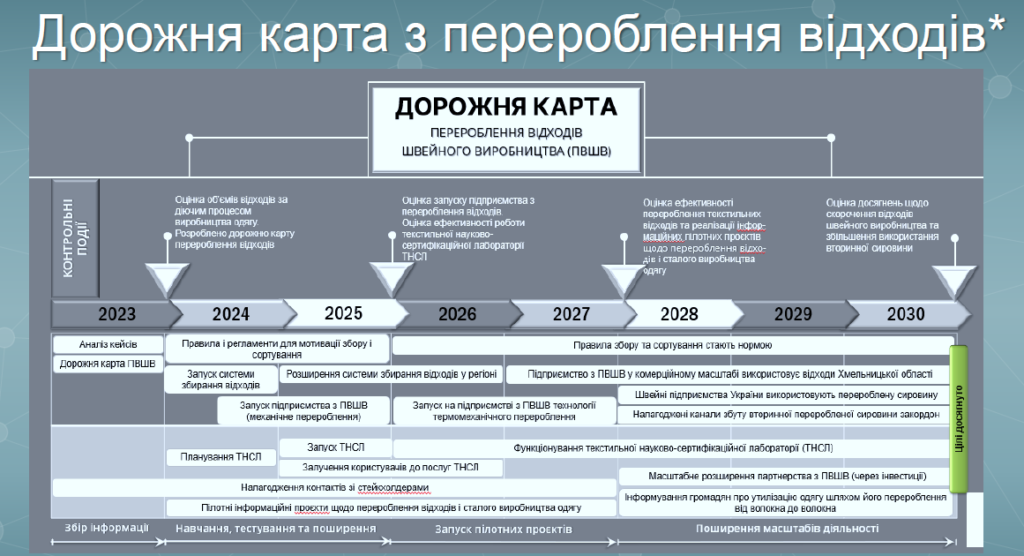
Some clusters in Ukraine are already moving in a similar direction. In particular, at the beginning of 2024, the Podil Fashion Cluster developed a comprehensive roadmap for recycling light industry waste until 2023, which is being implemented at the regional level.
Progress in Ukraine:
Some Ukrainian clusters are already advancing in this direction. For instance, in early 2024, the Podil Fashion Cluster developed a comprehensive roadmap for recycling light industry waste. This roadmap, designed for implementation by 2023, is now being rolled out at the regional level.
The Circular Economy Cluster invites enterprises interested in adopting recycling and reuse principles, sustainable energy, and resource conservation to collaborate. Your case studies and success stories are essential for our shared progress.
Prepared by Dmytro Lazarenko, CEO of the Circular Economy Cluster.