
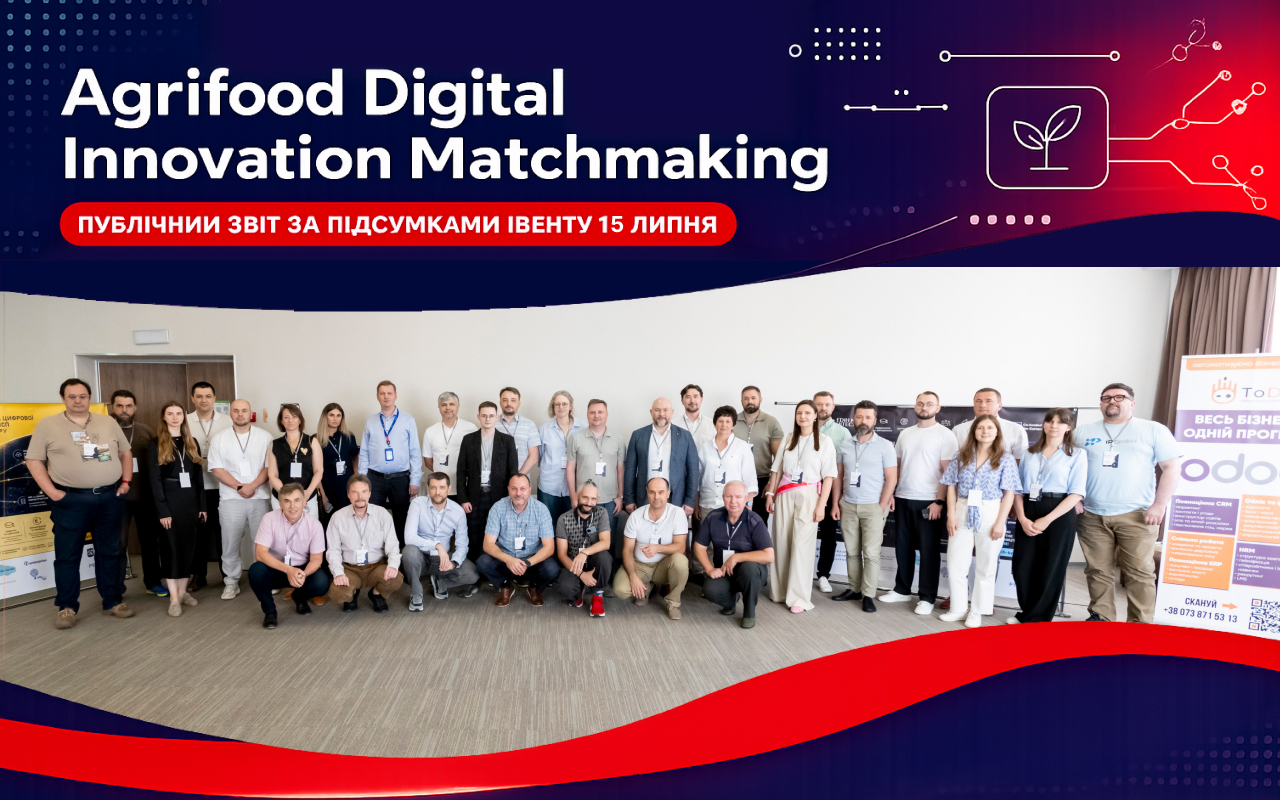
Agrifood Digital Innovation MatchMaking
Public report on the results of the event on July 15
On July 15, EDIH Kyiv Hitech gathered in one space in one space of 12 agricultural enterprises, 9 system integrators and a number of experts from universities, scientists and international partners. The main idea is a system brokerage, including matchmaking around real business challenges. The main results of the day include the completion of the formation of the portfolio of cases (pain points) of the industry, the portfolio of standard solutions and possible pilot projects. The partners and sponsors of the event were 5 APPAU integrators – IT-Enterprise, DigitaP, A-Gnostics, Smart Power Engineering and Interproject GmbH. More about this and other results of the 1st system, industry campaign EDIH Kyiv Hitech in this report.
Context of the event
This event was the 2nd and final in the campaign that APPAU has been running since March 2026. Then we started it with a series of publications and the first online event that took place on April 16. This first stage allowed the 4-top calls to be clearly identified as
- replacement of 1C/BAS and transition to modern ERP-systems,
- energy efficiency and energy efficiency,
- Real-time data accounting and management (MES)
- as well as solving personnel problems in production by automation.
And although these challenges, apparently, are common to most industrial sectors, the exchanges already revealed many specific problems in the issue of quality control, traceability and implementation of modern AI solutions.
Thus, the 2nd event in July was aimed at connecting specific enterprises in both demand and supply. At the same time, APPAU has increasingly involved EDIH Kyiv Hitech as the main basic institution designed to provide expert coordination and strategy in this sector. In the previous two months, the EDIH Kyiv Hitech team built a full-fledged Innovation Demand Pipeline: based on online polls and in-depth interviewsYu with manufacturers, produced 14 detailed business cases of real companies (dairy products, spices, beverages, frozen products, msampling), which are presented to the attached integrators and experts of EDH. The compilation of all independent sources gave a more complete map of demand: mass polls are dominated by energy, personnel and management accounting, while in deep cases the most common topic is product quality, real-time management, and manual replacement Works on robotic systems.
This portfolio formed the basis of several guides prepared for the event, and thus before the event, all participants could have complete information about the state of the industry.
Industry challenges
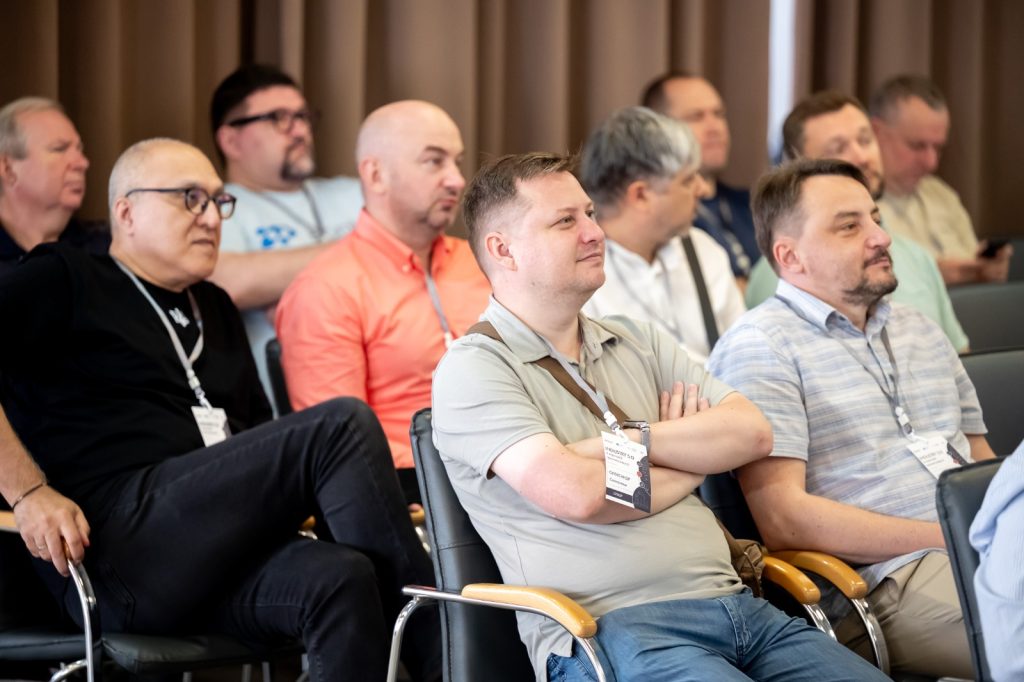
Yurchak Oleksandr, UCA Director, started the event with a general overview of the challenges and the state of digital transformation. The Ukrainian food industry is entering a new stage, and the figures given in the introductory analysis of APPAU outline 3 main macro challenges:
- Staff: 71-74% of companies in the industry are experiencing a significant staff shortage (about 9,000 open vacancies),
- Energy Cost: The industrial tariff for electricity increased by ~85%,
- Difficulties in EU accession (as the main market): European integration requires compliance with approximately 160 directives, from certification to traceability.
- Innovation Issues: Large Agroholdings Respond To This Innovation Investments, But For SMEs BarEP is not the cost of technology, but the lack of all innovation capacity: expertise, personnel, time, test infrastructure, financing and partnerships.
It is this gap that corresponds to the EDIH model – the ‘single window’ of digital transformation, which combines testing of decisions to investment (Test Before Invest), training, access to financing and the ecosystem of partners. According to JRC, 90% of companies that received European EDIH support have increased their digital maturity. Accordingly, the event on July 15 became the first practical demonstration of the model of cooperation from EDIH Kyiv Hitech and how this model works: do not ‘come to hear about technology’, but ‘bring your challenge – and go out with the outline of the pilot and understanding where his money. ‘
APPAU and NUHT experts (Maksym Tyutyunnyk, Oleksandr Pupenna) analyzed three end-to-end challenges of the industry and technological answers to them: energy resources (cogeneration, EMS-accounting for changes and types of products, AI-redevelopment of production under conditions of constraints), staff shortages (end-of-line robotics, AGV/AMR, digital doubles and technical cards, specialized software that accumulates competencies) and management accounting (1C / BAS migration, Through digitization, traceability). A separate thesis, which was then confirmed on the tables: the industry needs not only education but also education – awareness of technology and even the profiles of service providers today are critically low, and this is where the role of clusters, EDIH and their organization regular brokerage events.
Leadership Experience: AI is already working in production
The most powerful reference of the day was the performance of Astarte (Eugene Kovnir): this famous holding showed 8 AI projects in industrial operation – from auto-protocoling of meetings and scoring of counterparties to the computerUterine vision for sugar quality control at all 5 plants, drone crop analytics, identification of cow behavior and traffic control at beet stations. An important gesture of openness: Astarta publicly presented 7 planned projects open for cooperation – From OCapacious grain weighing to 3D stock estimates in silos – and these queries have already been set in Pipeline Edih for possible matchmaking with integrators.
IT-ENTERPRISE (Roman Yavorsky) – a company whose services are used by 76% of Ukraine’s largest food producers – showed the scale of industrial AI in figures: 225 thousand AI-apps every month, 20+ active AI-projects. and formulated, perhaps, the main technological thesis of the day – ‘Hierarchy of needs’ of digitalization: first the basic ERP and LAD in the data, then the process optimization, and only then AI-assistants give the maximum effect. This logic ‘Do not start from the roof’ has become a common denominator of almost all performances of integrators.
Practical cases of integrators
| Company | Key message and cases |
| IT-ENTERPRISE | The range of professional AI-agents in industrial operation: Assistant technologist for recipes (−90% of processing time), APS/MES-planning (service level 98-99%, +20% of equipment efficiency), AI-maintenance analytics (AI EAM, TechLink). |
| a-gnostics | PRO-GNOSTICS – AI-platform of energy consumption forecasting, green generation and electricity prices; The path ‘Data → AI → automation’ gives up to 8 hours / day of saving staff time. Among the customers – poultry farms, elevators, industrial consumers. |
| digitap | A single digital production platform instead of a ‘zoo’ systems: MES / MOM cases (OEE growth ~ 20%, downtime reduction to 80% in pharmaceutical production), agricultural processing data consolidation (Delta Wilmar), automation of a sugar factory with a technological archive with an accuracy of 100 ms. |
| Interproject GmbH | IP.Cloud TMS – Managed transport route at the enterprise: application → checkpoint → laboratory → weight → operation → documents → departure, with evidence of each action. |
| Smart Power Engineering | Energy Assets Management Platform: Integration of SNE, SES and EMS, day-ahead market (Energy Arbitration, Peak Shaving), container hybrid accumulation systems – savings on tariffs up to 30-60%. |
Where is the money for this: 18 sources of funding
Fundraising unit EDIH Kyiv Hitech (Lesya Sobolevskaya) presented a review of 18 current sources of funding in 4 categories – EU grants (Horizon Europe, Life, EIC, EIT Food), programs Agritech ecosystems, international donor support (Mercy Corps, STDF) and government programs of Ukraine (Action, Entrepreneurship Development Fund) – with the practical logic of choice: “There is no best grant – there is a grant for your stage and conditions”. Feature of this block: Direct Mapping ‘Solution Type → Case from Guide → Proven Grant’, ie fundingIt is not related to abstract topics, but to specific challenges of the portfolio. The proposal is formulated clearly: the grant is not a goal, but a way to finance the implementation of the solution, and where to start with the production problem.
The unit has complemented the capabilities of Enterprise Europe Network – the world’s largest SME support network, whose services are free for Ukrainian companies – and the experience of NOSC-UA DIH in international agrofood projects (Trust-Food, CADS, Farmtopia), which opens the way to European consortiums. Industry partners – the TatFood technologists community and the U-Food Association, in turn, have shown how the ecosystem enhances both personnel and export dimensions of transformation.
Matchmaking is the brightest moment of this event
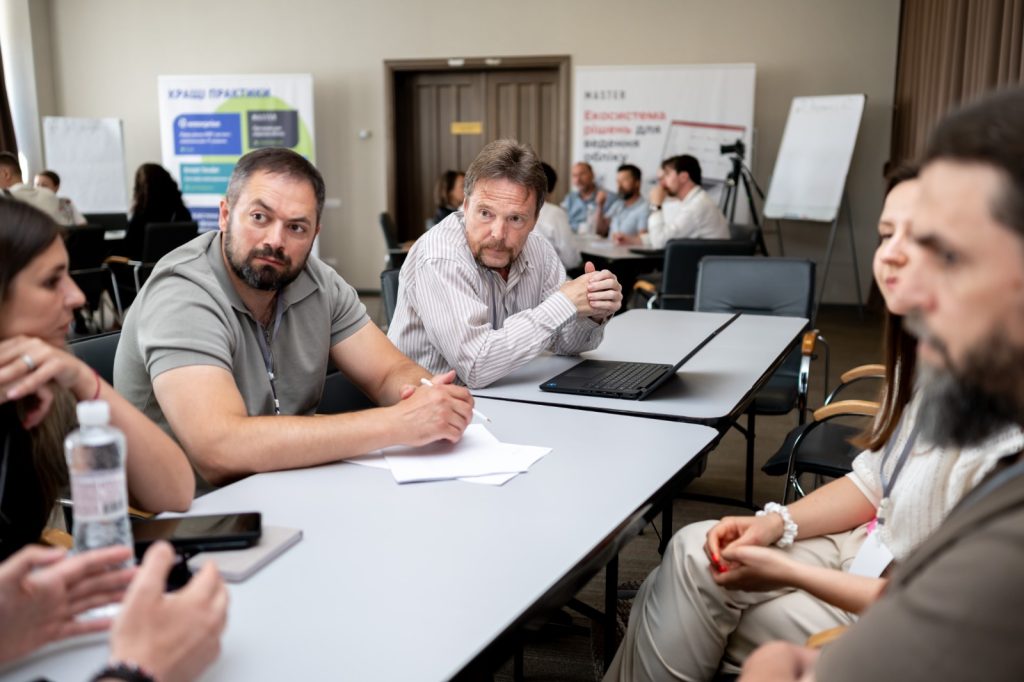
According to the participants themselves, the most striking and useful moment of the day was a matchmaking session in the format of a world cafe. According to the identified topics of key challenges, the organizers proposed 5 thematic tables: energy autonomy, automation and robotics, modern MES, AI-agents and migration with 1C. Enterprises in small groups visited each of them in turn, after which the moderators publicly presented the work on a single logic ‘Problems → possible solutions → outlines of pilots.’ The main public conclusions of the tables:
| Table | The main conclusion |
| Energy autonomy and energy efficiency | Participants formulated a methodology for entering energy projects: independent audit → projection with a laid extension → structured funding → one turnkey contractor. In parallel and regardless of this, there should be actions in the wide market education. The first pilot with a specific customer and executor was recorded, the new pain “where to get financing” received a direct response in grant mapping (in particular, energy credit 0% – up to UAH 10 million per generation). |
| Automation and robotization | The most ‘contractual’ table of the day: three outlines of the pilots, each with the named customer company, the executor and the measured success criterion – from MES at the unit msampling production to Kobot on the packaging area with a bar ‘twice less staff with the same productivity.’ |
| Modern MES – production planning | The cleanest diagnosis of the day: 4 of the 4 groups independently confirmed – the main barEP is not technology and not money, but understanding what MES is (even at the top management level), and the lack of specialists. Table recommendation: multi-level practical education, industry standard (OT / IT reference architecture for food SMEs) and small pilots on prepared sites. |
| AI-Agents: What’s already possible today | The main insight of the day: all customers present are already creating their AI-agents. But according to their estimates, only ~ 20% of AI applications in enterprises are currently effective. The reason is not the technology itself, but the way of mastering: users are somewhat confused between professional agents (on private data, built into systems, with a measured effect) and amateur experiments on public platforms. Answer EDIH – it is necessary to launch an educational program ‘Industrial AI’, a catalog of proven Ukrainian AI-agents and collective Quick Wins like a typical AI-policy of the enterprise. |
| Migration with 1C / Modern ERP | The topic, which 13 of the 30 companies named among the main ones: software replacement is not an option, but a requirement with a 2030 deadline, and what is started later, the transition is more expensive. Detailed results of the table will be provided separately to the participants of the event. |
Almost all 5 tables, independently of each other, led to the same conclusion: the largest market deficit – Independent expertise and education of end customers. ‘First, explain and count – then sell,’ – so formulated the companies themselves. For EDIH Kyiv Hitech, this is a direct mandate: the role of an independent thought leader in the digital transformation of the agricultural industry today is vacant – and EDIH will take it on – white books, standards, catalogs of proven solutions and educational programs, but in First of all, the mobilization of relevant experts.
The first results of the event
Expert consolidation of the industry around digital transformation is a process more than one day. But that is why it is now important to note that a significant part of the tools presented on July 15, Created in Ukraine for the first time – And this markedly distinguishes the position of Edih Kyiv Hitech in public space, including among other EDIH:
| The achievements of the event | What does it give the market |
| public portfolio of 20+ verified business cases of the industry | The company recognizes its challenge in the cases of colleagues and immediately sees the digital approach, the format of the pilot and the first step – instead of abstract conversations about “digitalization”. The cases are collected “from bottom to top”, from real requests from manufacturers. |
| Exit to understand the main trends and drivers | The case portfolio is only part of the important information received before, during and after the event. Together, this analyst allows us to more clearly draw conclusions about the state of the industry, the readiness of enterprises and their key pain points. In turn, it is the basis for the formation of a larger road map of the digital transformation of the industry. |
| Three guides for three audiences: SME leaders, integrators, international donors | Based on the developed cases, each participant of the ecosystem receives a tool in its own language – from a practical navigator for the owner to the offer of a strategic partnership for 3-5 years for donors. |
| Practice algorithms for requesting requests due to independent experts | Cross-cutting navigation from problem to funding: Each of the cases presented will receive its processing, the responsible EDH manager, and also consider funding opportunities. |
From the point of view of the entire ecosystem of Industry 5.0 in Ukraine, this event is the beginning of the establishment of an internal ‘standard’ of conducting brokerage events according to a single methodology. In essence, this event demonstrates the full cycle “Collection of specific cases and their systematization → selection of the most relevant service providers, as well as grant proposals → matchmaking → access to specific pilots → Financing. EDIH Kyiv Hitech plans to further scale this event to the sectors of mechanical engineering (December 2026) and the medical industry (February 2027). The clusters of the Ukrainian cluster alliance are top partners who are already invited to these events.
The common denominator of these ‘for the first time’ is the bottom-up approach: we do not offer a catalog of technologies that someone wants to sell. On the contrary, it is about structured, measurable demand of real enterprises, around which solutions, pilots and financing are built. There is already a precedent for such an approach in Ukraine – created by APPAU in 2024 First Industry Double Transition Road Map for Light Industry And the agro-food industry is the following. Of course, we really need financial partners for such works, but even in this event we have proved that we can mobilize our own members of the community and that is the strength of clusters and businesses.
Next steps
The event on July 15 ended not so much with the outcome as the start. The next steps announced on July 15:
| Step | Content and terms |
| Round table reports and pilot validation | Detailed reports of all tables are sent to all participants of the event. By August 1, we also plan to coordinate with those companies that have submitted their business cases. The option of creating a working group Agrifood Industry 5.0 is considered separately. |
| Digital Transformation Program Agrifood SME https://digitalprogramm.edih-kyivhitech.com/ | On July 15, we announced a broader program to support production SMEs (any industries). The first cohort includes only 20 individual businesses, Where is Digital Maturity Assessment (DMA) included, expert interviewsYu, opportunities to develop an individual roadmap, Test Before Invest pilots, grant support and access to EEN networks. The program also includes three levels of engagement (explore/develop/transform). Applications are submitted by July 30, start – August 2026 and the set is already underway! |
| Educational programs | EDIH will launch a series of educational programs in September. The “Industrial AI” programs in the so-calledlanguage with the ERP / MES educational series, including the 1C / BAS replacement. |
| Branch white books and standard | EDH organizes expert working groups, the task of which is to systematize educational materials on topics, as well as the publication of new white books. Among them, the priority is the topics of ‘Energy Autonomy’, MES / MOM-systems, migration with 1C / BAS. |
| Business Case Submissions — Permanently | Form of submission of new cases from There are manufacturing enterprises open and invites new customers: 15 minutes – and the call of your company gets to Innovation Demand Pipeline with a free expert interviewand target selection of the most relevant service provider. |
Despite some organizational difficulties, the 1st brokerage event EDIH Kyiv Hitech fulfilled its mission. For the first time, we have shown the format of the event, which shows the key challenges of a particular industry, and further connects advanced service providers with end users, raises funding, but at the same time – offers specific initiatives that bring the entire industry to a new level.
The organizers thank the main partners and sponsors of the event – IT-Enterprise, A-Gnostics, Interproject GmbH, Smart Power Engineering, Digitap; industry partners – U-Food, TatFood, Ukrainian Agrarian Confederation; Speakers of Astarte, NUHT, Nosc-UA DIH and all moderators of tables. The event was organized by APPAU, the Ukrainian Cluster Alliance and EDIH Kyiv Hitech with the support of the Enterprise Europe Network project in Ukraine.
Directorate of the Ukrainian Cluster Alliance