
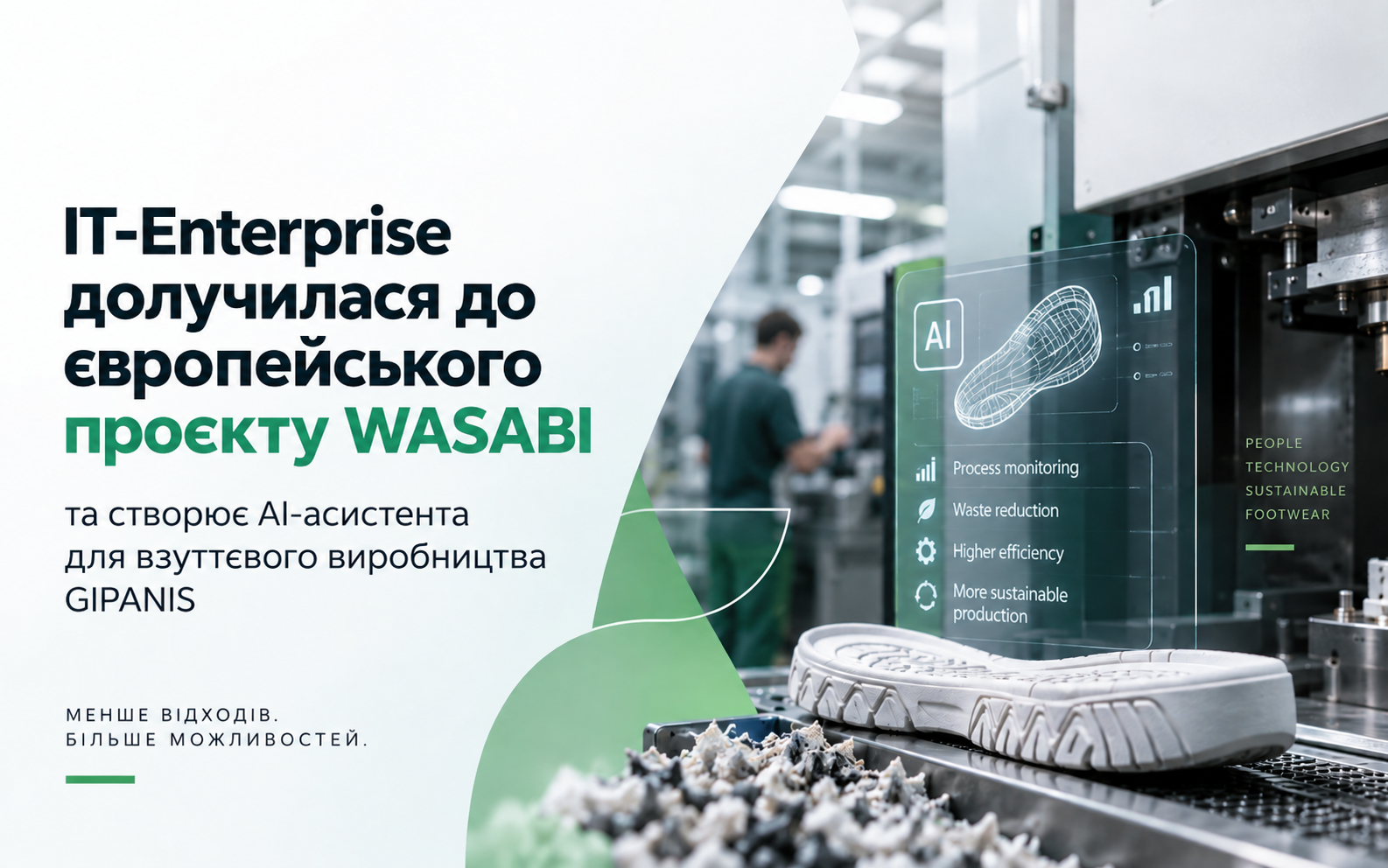
IT-Enterprise has joined the European project WASABI and creates AI-assistant for footwear production Gipanis
Ukrainian product company IT-ENTERPRISE, GIPANIS PRODUCTION ENTERPRISE PROCEDURE The expertise within the European project WASABI was combined to implement the AI assistant directly into the production process of footwear making. The solution should help shoe and light industry enterprises reduce industrial waste, control technological parameters and increase energy efficiency.
The project is implemented within the framework of the EU Horizon Europe program and the CIRC-Shoe experiment, which provides for the introduction of a digital AI assistant – AI-WVMA (AI Waste Valorization & Monitoring Assistant) – on the line of production of EVA-components (production balances) at the enterprise Gipanis.
In the project, GiPanis is a production partner and platform for testing AI-solution in real-life conditions, IT-Enterprise provides technological integration of ERP and analytics, and Astar and EDIH Clotex Hub support digital Transformation and dissemination of project results.
‘Wasabi is interesting precisely because it combines the interests of all participants in the project: for Gipanis it is a tool that solves daily production tasks now, for Astar – a practical example of digital transformation, which can be distributed among enterprises in the region, and for IT-ENTERPRISE – an opportunity to develop AI-technologies on real industrial data. That is why we consider this project as a model that should be scaled to the whole industry, ”he said Oleksandr Ochkasov, head of the IT-Enterprise AI project.
The main task of AI-WVMA AI-assistant on the GiPanis injection machine to convert technological data into real-time operative clues for employees and optimize production. The AI model allows to eliminate ‘reaction gap’ and to reveal deviations of temperatures, pressure or injections before emergence of lack or overspending of resources. AI-WVMA remains a tool for supporting decisions, maintaining control over a person.
The introduction of AI also solves the systemic problem of EVA material loss (limits and scraps). Instead of recycling or cheap sales, waste is analyzed for reuse. This reduces the cost of production, reduces energy consumption and reduces carbon load, which ultimately brings economic and environmental effects to business.
The GIPANIS experience can become a potential model for the entire light industry. In particular, within the framework of the European project, WASABI is already considering the possibility of implementing this AI-system at 8-12 more Ukrainian enterprises over the next two years.